
In this 4-part blog series, the Kinomatics team takes a deep look at a recent, contentious tally of Australia’s Top 50 Films (of all time), as an example of what we call “Top Listing”. Top Listing is when an organisation or commentator creates and publishes an ordered, delimited ranking of phenomena (films, books, hamburger joints, shades of blue and so on). Typically this takes the form of media reports promoting an incessant stream of annual Top Tens but it could also include specialised lists of “the world’s most livable cities” or “best performing universities”. Top Listing well precedes the internet but has burgeoned in an algorithmic era that relies on low-hanging clickbait to drive engagement.
I was one of a number of academics, critics, curators and filmmakers who was invited to provide my list of Top Ten Australian movies to a media outlet which then collated and ranked all the selected films in order to determine the winning Top 50. In a way that I am sure perfectly pleased the editors, the resulting list inspired a raucous debate about the value and quality of Australian film and film criticism. In particular, pundits complained that the main thing the list revealed is that there is no broadly agreed Australian movie canon.
PART ONE: VIRTUOUS CIRCLING
I could be writing a post about the top ten reasons I hate Top Ten lists. Yes, they are reductive. No, culture doesn’t come in decimal categories nor biblically tabular ones. Absolutely, they assert hierarchies of taste and by implication anoint an elite group of tastemakers. The New Yorker critic Emily Nussbaum staked her reputation for annually hating on Top Ten lists for their “aura of fake authority; the apples-to-oranges problem; the math; the level at which I was simply loath to adopt the values of those rank-happy dudes”. I do so love the phrase “rank happy dudes”….
When I worked as The Melbourne Times film critic I staged my own small attempt at maths resistance, holding out against the now ubiquitous 5-star rating system for years. Later, as an academic mostly working with computational and economic analysts on film data, we set out to imagine more nuanced and democratic ways to think about the mathematics of ranking cinema, annually and more extensively.
Top Listing does have its fans. For Don Kois writing in The New York TiImes it is an opportunity for the critic to reflect on their own values and aspirations: “In building a Top 10, you are also creating, in 10 increments, the person you want to be, the taste you wish to have.”
Despite reservations (“Top 10 lists are artificial exercises, assertions of critical ego, capricious and necessarily imperfect”), Kois’s colleague at The New York Times, film critic Manohla Dargis also signaled her appreciation by suggesting that the value of the year-end Top 10 was its function as a kind of public ritual. For Dargis, public rankings were a case of, “I tell you what I liked, and you either agree with my list (which flatters us both) or denounce it (which flatters you). It’s a perfect circle.”
I like this shapeshifting idea, that the list is not a descending line but is in fact a circle. What Dargis is also suggesting is that, as much as Top Listing is a labour of criticism, its real merit lies in the declarative challenge to others. And if we extend her thinking along these lines, perhaps the virtue of the list then, is not so much that it is a circle but that it circulates.
Top Listing is calculated to provoke the inner critic in other people and to contrive a kind of public imaginary kinship. It is an invitation to position ourselves (to evaluate ourselves) somewhere, somehow in relation to the listmaker – for, against, partially, fully, furiously, indifferently and so on. Top Listing urges, not just the critic, but all of us to imagine the person we want to be, the taste we wish to have, relative to others.
With this in mind, Kinomatics has approached The Top 50 Australian Film list from the perspective of relative positioning. We use social network analysis to try and understand patterns of alliances and divergences, the presence of inner and outer circles, voting proximity and distance. This first post in our series will focus specifically on the voters who participated in the tally.
The Top 50 Films of Australia, ranked.
For our analysis we accounted for all the voters and all their Top Ten nominations. Some of our findings are limited to the films that made the final Top 50 and some include analysis of all the nominated movies.
In short: 24 expert voters compiled Top Ten lists that resulted in a total of 104 nominated films by 83 directors. Two voters, David Michôd and Warwick Thornton nominated an extra movie (11 rather than 10 films) which we have included and there was one film nominated by Gillian Armstrong – Black Dress – that we cannot definitively locate so we left that out of the mix. This has the unfortunate effect of giving greater weight to the data contributed by Thornton and Michôd and slightly underweighting Armstrong’s contribution to the analysis.
Voters included a number of esteemed film directors, and many of these same names also appeared in the Top 50: In fact of the 10 voter-directors (Warwick Thorton, David Michôd, Bruce Beresford, Gillian Armstrong, Phil Noyce, Jennifer Kent, Kriv Stenders, John Polson, Unjoo Moon and Robert Connolly) only three did not end up with a film in the final fifty.
In looking at the data, we wanted to ask: To what extent did voters overlap and were there distinctions between the kinds of movies selected by different kinds of voters? For example, do filmmakers differ from critics in terms of how they define excellence?
Here is a network visualization which describes how voters were interconnected by their choices (Figure 1). The more people a voter is connected to, the more people nominated the same films they did.
So if we look at the selections made by academic Adrian Danks, his Top Ten contains films that were only included on lists created by five other people. Only eight people selected films that appeared in my Top Ten. And so on. On the other hand the Top Ten lists created by Margaret Pomeranz, Hoa Xuande, and Unjoo Moon featured films that were the most widely shared across all the voters (they each have 20 other people that nominated at least one of the same films they did).
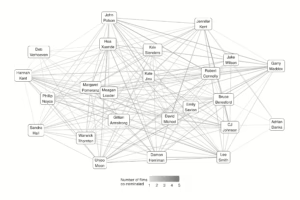
Figure 2 shows the same network but colour-coding for “filmmakers” (directors, screenwriters, actors, editors) and what we might call “tastemakers” (critics, curators and academics).
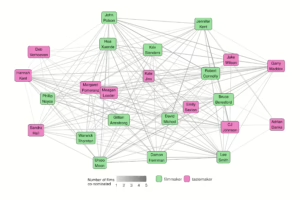
It would make sense that people who tend to hang out together at industry events (the AFI Awards for example) might form a coherent social group distinct from those who organise and/or hang out at film festivals or are members of critics’ associations for example. What I thought I might see – but didn’t really find – was filmmakers broadly agreeing with other industry personnel in their choices; and conversely commentators and critics broadly concurring with each other. But the data does not suggest this is the case.
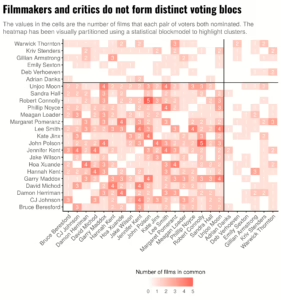
Even if we dig a bit more explicitly using a heatmap (Figure 3) to show who specifically was in agreement with whom there is no significant pattern distinguishing filmmakers from critics, although John Polson and Robert Connolly (both directors) do seem to be furiously in agreement (sharing 5 nominated titles – the most). If anything and with only scant data it does suggest that academics (Danks, Verhoeven) are the most disagreeable voters and tend to choose outliers. What can I say?!
Drawing a Line and Making a Circle
I think – given the thousands of films to select from – the broad agreement of most of the voters to reward a relatively small cohort of movies is suggestive. It seems, there do exist invisibly agreed laurels of bestowed prestige in this specific instance of Top Listing. And sure, there are a handful of choices that distinguish voters from each other, but by and large, most voters (filmmakers and tastemakers alike) overlapped to a high level of consensus.
This is how Top Listing produces not just a list of movies but a cultural coterie, an inner circle if you will. This is a group of people that are not clearly defined by common occupations or salaries (although they are all what we would broadly describe as cultural workers) but rather they share a fluency in the codes of contemporary cultural capital as they apply to Australian cinema. They somehow know the right films to name-drop. They are always, already “in the know”. From this perspective, Top Listing bestows cultural capital on the voters themselves as much as the films they nominate.
Writing about the entangled sensibilities of cultural workers as arbiters of taste, Dave O’Brien and Lisa Ianni make a similar observation. Their research shows that it is not what content is rewarded (which specific films for example), but the perception of the depth of appreciation, and the willingness to articulate a commitment to engagement with culture that really matters.
For O’Brien and Ianni, this shared orientation to the discernment of prestige between creatives, commentators and curators, takes the shape of a spinning cultural circumference that acts like a self-fuelling vortex. In this configuration, the self-reinforcing circularity, rather than self-reflective opportunity, of Top Listing is cause for concern.
“These distinctive tastes of cultural workers matter because, as creators, commissioners and curators of what ends up on stage, page and screen, cultural workers’ tastes shape the cultural hierarchies of which they are a part. In the context of cultural and creative industries, we can expect that these new forms of distinction will serve to create group identities, providing yet another way that cultural elites are socially closed, in addition to well-known exclusions based on demographics such as race, class, gender, age or disability.” (O’Brien and Ianni)
Next
In our next post on the Australian Top 50 Movies (of all time), we will dive into one of these demographic categories in detail by looking at how gender intersects with these new forms of cultural distinction.